
All change!
When the railway first came to our villages
by Graham Lewis, with acknowledgements to Richard Standing
The opening of Angmering Station on 16th March 1846 altered the face of travel in Rustington, East Preston and Angmering, bringing about significant social and economic changes to this largely agricultural area. Many more people were able to explore the world beyond their rural village, and in an era when roads were notoriously bad, the faster journeys achieved by train enabled the coastal strip to develop a successful market gardening industry, with produce travelling to London and beyond. Tomatoes and flowers were the principal crops.
The construction of Britain’s railways began in the 1830s in the hands of a large number of independent companies, authorised by parliament, but with no overall plan or co-ordination. The London & Brighton Railway Company was responsible for the scheme to link these two centres of population, but it seems a line westward along the coast from Brighton had always been an essential part of the scheme. In 1837 the company was given permission to build a line from Brighton to Shoreham, as well as its main line from London. As a port, Shoreham was a potentially profitable destination, but it was clearly foreseen that a line westwards from there was desirable.
A few years later, the London, Brighton & South Coast Railway was formed from several smaller companies and it was the LBSCR which built the line we know today, reaching Worthing in 1845, followed by Angmering and then Chichester in 1846. Leaving Shoreham, the first station on the new line was Lancing, followed by Worthing, Goring and Angmering. The original station at Angmering appears to have been an attractive flint-faced building with twin gables. After Angmering, the next station was called Littlehampton, though this was situated near the level crossing in Lyminster, two miles north of the town. The next station was Arundel (now Ford station) and the spurs to the town centre stations in Bognor and Littlehampton were added in 1864. Barnham Station was built in that same year.
The 1853 passenger timetable shows that there were four daily trains from Angmering to Brighton and four trains a day to Portsmouth. To travel to London, a change at Brighton was essential, as the loop between Hove and Preston Park wasn’t built until 1879.
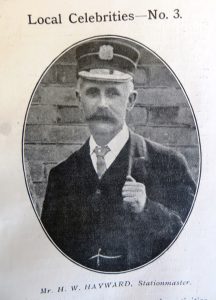
In 1854, Angmering Station was provided with a goods yard on a large piece of land to the north of the line, donated to the LBSCR by the Squire of Ham Manor, William Gratwicke. The goods yard is now the station car park but the old engine shed still stands today and is used by a tool hire business. The second (and present) station building, dating from the 1860s, included a house for the station master or other key staff. A signal box was constructed in 1877 on the south side of the station adjacent to the level crossing, but this was removed in the 1990s when the signalling system was centralised. In its earlier days, Angmering station wasn’t just a railway station, as the station master (sometimes designated simply as a “clerk”) also served as the local postmaster. From here, mail for Angmering, East Preston, Kingston and Rustington was sorted and distributed. The opening of Angmering Station didn’t just transform the local economy and people’s way of life. It also resulted in the name of the road leading from Rustington to East Preston being changed from East Street to Station Road, and the latter name continues right through Angmering to Water Lane.


