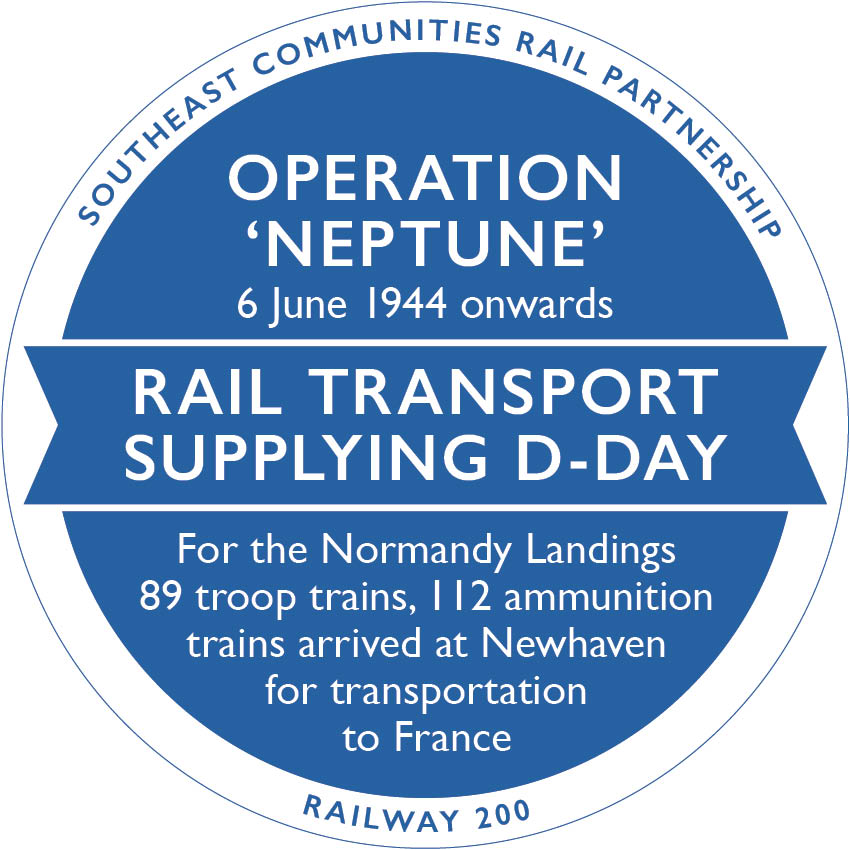
6 JUNE – 31 JULY 1944
89 troop trains, 112 ammunition trains arrived at Newhaven for transportation to France
During World War II after almost 6 years of war with Germany, and 4 years since over 300,000 Allied
soldiers were evacuated by boats, large and small, from the German-blockaded beaches at Dunkirk in May
1940, a countdown had begun towards a military operation codenamed Overlord. This would be an intense,
liberating invasion of huge proportions by the Allies into German-occupied Western Europe. It would
involve 1200 airplanes and over 5000 vessels by sea, with 160,000 troops crossing the English Channel on
day one known as D-Day, the 6 June 1944.
The sea-borne element of Overlord was codenamed Operation Neptune. And as D-Day approached troops
began mustering on the English coast as Richard Kirkham, Trustee of Newhaven Historical Society
explains: “Railway employees in the Newhaven Marine Workshops applied their skills to the repair of motor
gunboats, torpedo boats and air-sea rescue craft. As D-Day approached, the harbour became filled with small
craft, berthed almost from shore to shore. Camouflage netting was strung across the river Ouse north of
Newhaven to conceal the build-up of craft from enemy reconnaissance flights.
Tank landing craft were positioned on the west side of the harbour – there is still a slipway built to allow
tanks to drive directly onto the vessels in the present-day marina; grid irons were added here to facilitate the
quick repair of ships. Meanwhile, troops were based to the east of the river Ouse as they arrived by train.
The railway came into its own, feeding a continuous supply of troops into the port to prepare for the
landings. They disembarked at Newhaven Town and Newhaven Harbour stations and transferred into the
plethora of ships and landing craft that awaited their arrival. This was probably the first time that troops
realised the scale of the enterprise they were joining. The delay of D-Day from 5th to 6th June [because of
bad weather only] added to the tension.
Details of the train service requirements are sparse but can be gauged by the 62,000 troops who embarked
for France between D-Day and the end of June. The month of July saw a further 100,000 men sailing from
Newhaven for France.
During this period, many cross-Channel steamers returned to Newhaven to ferry troops. The railway
steamers Biarritz, Canterbury, Isle of Guernsey, Isle of Thanet, and Victoria were frequent visitors. One
can imagine the bureaucracy involved in processing over 3,000 troops each day to ensure they ended up on
the right vessel. The Maid of Orleans left Newhaven on 27 June but was torpedoed and sunk on her return
crossing from Normandy the following day.”
NOTES/LINKS
https://www.southeastcrp.org/the-part-played-by-the-railways-in-newhaven-on-d-day (Richard Kirkham, Trustee of Newhaven
Historical Society)
https://www.iwm.org.uk/history/how-d-day-was-fought-from-the-sea
https://en.wikipedia.org/wiki/Normandy_landings