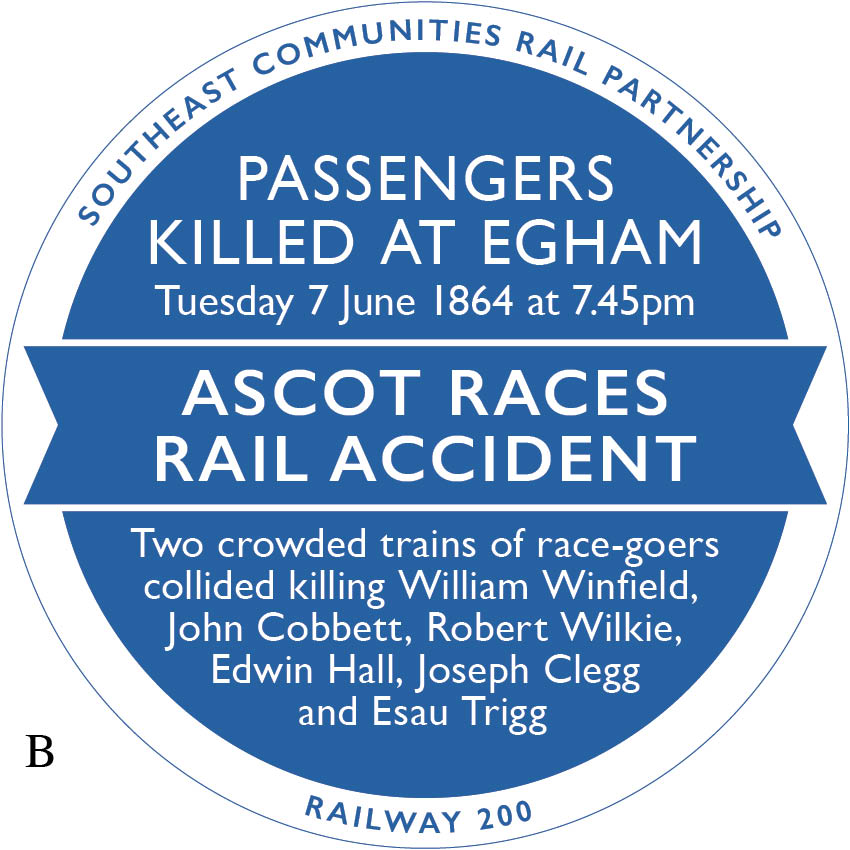
A racecourse, a ‘Royal Racecourse’ at Ascot was first established in 1711 by Queen Anne. With the coming
of the railways Ascot station opened in 1856, welcoming its first race-goers by railway in 1857.
Ascot’s first day of racing in 1864 was Tuesday 7 June. The Prince and Princess of Wales (the future King
Edward VII and Queen Alexandra) were in attendance. Racing had been running late and railway officials
were concerned about the sudden rush of passengers. Trains were run rapidly one after another. There was
an on-board altercation at Egham about card sharpers on one train which lead to a short delay, but it was
enough for another crowded train behind to catch up, despite it not travelling at a great speed. At about
7.45pm these ‘special’ race day trains collided, crushing the guard’s van at the rear to “splinters” but luckily
the guard had jumped clear. Described in the Buckingham Advertiser as “those long, unmanageable trains,
heavily laden with holyday makers”. Five men died at the scene, a the sixth dying from his injuries a few
days later. Injuries were often described in the newspapers in all-too-vivid detail that we shan’t repeat here.
The dead were:
•
William Winfield, gardener to Mr Bracebridge, Sherbourne
•
Edwin Hall, corn chandler, 6 Duke St, Manchester Sq, London
•
John Cobbett agent to racing celebrity Mr Padwick, Hill St, Berkeley Square, London
•
Robert Wilkie, publican Glove Inn Kings Road, London
•
Joseph Clegg, publican Harp Inn, Jermyn St, London
•
Esau Trigg, Brighton publican (Hero of Waterloo Inn) 34 Lower Market Street, Hove – died a few days
later at Charing Cross hospital