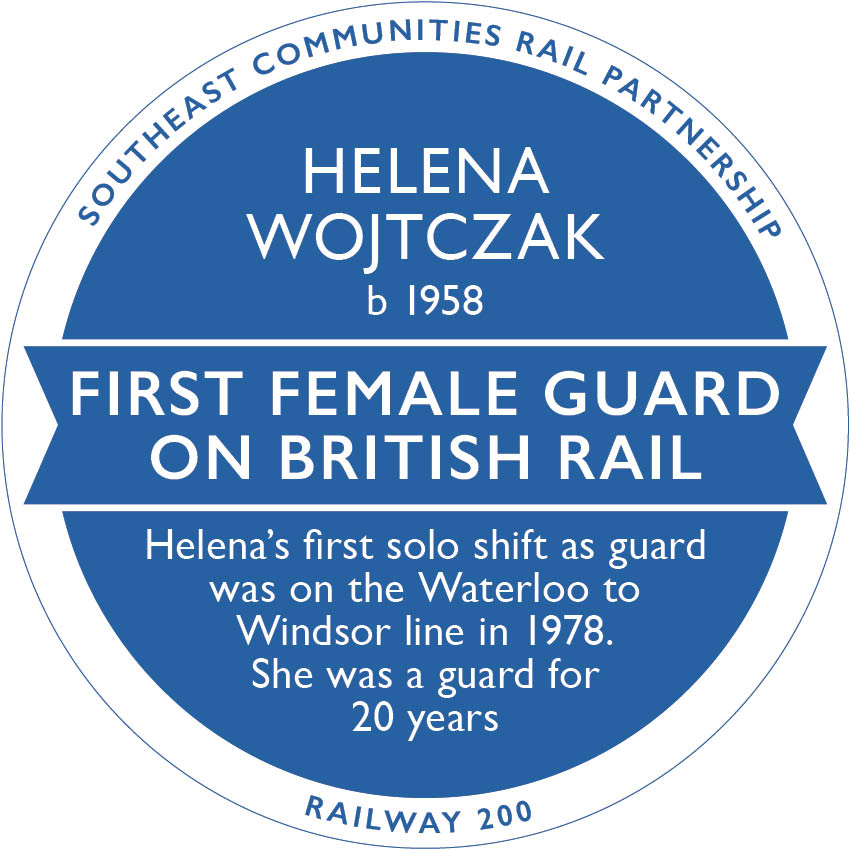
Born in Sussex in 1958, Helena trained as a GPO switchboard operator, which led to a job as a telephonist in
British Rail’s Southern Region at Waterloo in 1977. She realised very quickly that the job didn’t suit her.
She disliked being on the periphery of the railway industry not in the thick of it. Stories of a colleague’s
husband’s new career as a guard piqued her enthusiasm. The Sex Discrimination act had come into force
a couple of years before – promoting equal opportunities regardless of gender – so encouraged by her
female colleagues to become the ‘first lady guard’ Helena filled in the application form. Needless to say her
application progressed grudgingly; they hoped a medical exam and tough training courses would weed her
out as an inadequate candidate but she passed them all. She was in! On her week’s induction, obviously the
only woman, she learnt first aid, and about railway rules and laws.
Between courses she did a stint at Wimbledon Station. Her first uniform was a male guard’s jacket with jeans
and Doc Marten boots. She was treated as a celebrity, the first woman ‘learner-guard’ and treated as one-of
the-boys.
On the a shunter’s course she met some hostility. Accused of taking work away from a man. On this course
Helena recalls she “had to lift a notoriously heavy ‘buckeye’ coupling’ … too heavy for any woman to lift.
A semicircle of tormentors gathered around sniggering when my turn came. I knew this was the end of my
brief sojourn on the ‘real’ railway: not only would I never be a guard, I would exit utterly humiliated and to
a chorus of jeers and ‘told-you-so’s’ from my harassers. The thought of this, and the feeling that all women
would be judged on my success or failure, gave me the strength to lift it. But there was no applause and no
apology.”
The guard’s course followed. Learning how “all the various signalling systems worked, and procedures
for dealing with every emergency that could possibly arise: collision, fires, signal problems, derailments,
drunks, drug-takers, objects on the track”. She passed with 80% and moved to her depot, Wimbledon Park,
where she met a little animosity, “especially from those who had failed the guards’ course”. She was even
accused of getting the job through favouritism. Six weeks on the ‘road learning’ involved accompanying
senior guards on their shifts, day and night. She was welcomed into the card games in the smokey mess
room. “Seeing the sun rise over a Berkshire field covered with rabbits and set over the Solent were magical
experiences. And what can compare to the view from the front cab of a train rushing through a snowstorm at
90 mph” she says.
Sixteen weeks since her application, on 23rd March 1978, she worked her first train alone. The 12:46 return
Waterloo to Windsor. She was still only 19.
In her spare time Helena had studied for a degree in Sociology and Social History and she became a full
time historian following a railway career-ending accident in 1999. Her particular focus has been on Victorian
women, publishing several books on the subject, including her well-regarded book ‘Railwaywomen’ which
took 10 years of research into their hidden histories.