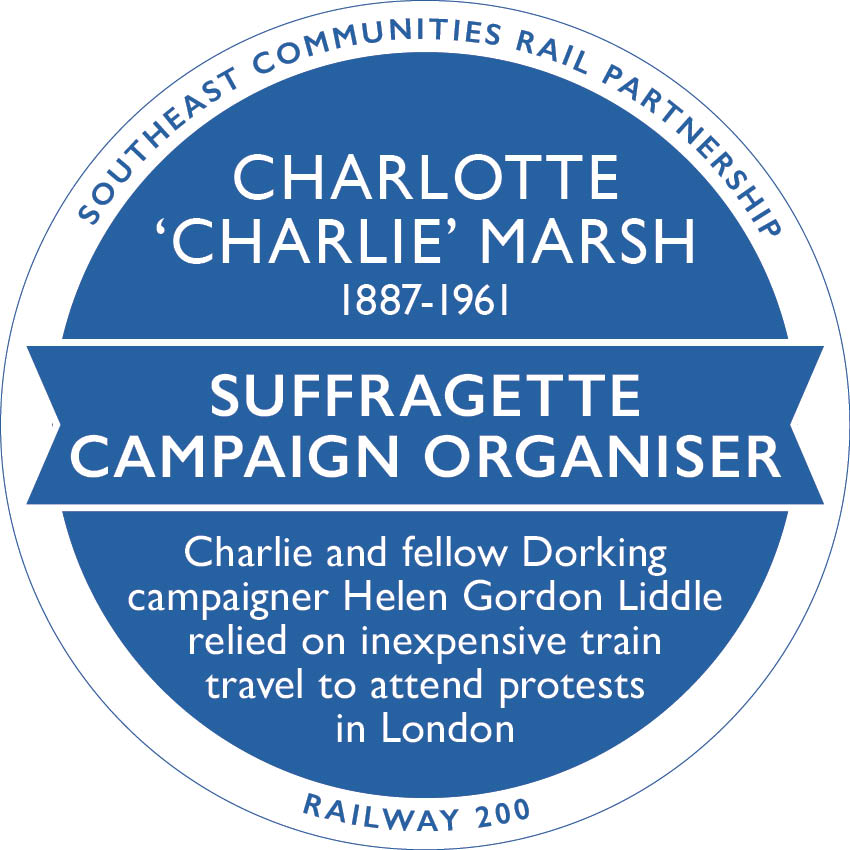
CHARLOTTE MARSH
1887-1961
Suffragette campaign organiser – ‘Charlie’ Marsh relied on inexpensive train travel to attend protests in London with fellow Dorking resident and suffragette Helen Gordon Liddle. Born in Newcastle-upon-Tyne in 1887, to Ellen and Arthur Hardwick Marsh, who was a well-known watercolourist,
Charlotte Augusta Leopoldine Marsh had four sisters and two half-sisters. She was sent to Bordeaux
finishing school and had training as a sanitary inspector.
Aged 20, she joined the Women’s Social and Political Union, a campaign group – founded by Emmeline
Pankhurst, engaging in direct action and civil disobience – for a woman’s right to vote in UK public
elections. Charlotte became a full-time organiser, and would hand out Votes for Women leaflets and parade with placards. However in 1909 she was one of three women arrested for throwing tiles from the roof of Bingley Hall, Birmingham onto Prime Minister Asquith’s car below, in protest of being refused entry to a
political meeting. The three were the first suffragette hunger strikers to be forcibly fed, Charlotte a reported
139 times, before her release. She was awarded a Hunger Strike Medal ‘for valour’ by the WSPU.
In the 1911 census, aged just 23, Charlotte was living on Portsmouth, and described as ‘Organising
Secretary, Womens Suffrage League’. This was at a time when many suffragists boycotted the census – in
fact, written across her census return the enumerator has written “This person… absolutely refuses to fill up
paper”. Working from home at 43 Howard Road, Dorking (where there’s a blue plaque in her honour in
1912 Charlotte organised the suffragette campaign and travelled up and down to London by train.
During the First World War when David Lloyd George, the next Prime Minister, was still Minister for
Munitions, he employed her as his mechanic and chauffeur. a political gesture, knowing the country relied
on women to fulfil mens’ roles during a war.
Charlotte wasn’t wealthy and relied on trains to campaign, attend marches and meetings. Even special trains
were laid on for large marches. Occasionally though trains and stations themselves were targets of fires
or explosions, such as Oxted station and a train at Teddington, both occuring in the days following Mrs.
Pankurst’s conviction for incitement (and 3 year prison sentence) in April 1913, were allegedly the work of
militant suffragists.
In the Representation of the People Act of 1918, women (over the age of 30 who met certain criteria at least)
were finally given the right to vote. This age limit was brought down to 21 to equal men in 1928, and 18 for
all in 1969.
https://suffragettestories/charlie-marsh
https://en.wikipedia.org/wiki/Charlotte_Marsh
David Lloyd George’s suffragette chauffeur | Illustrated London News
https://nationalmotormuseum.org.uk/story-of-motoring/online-exhibitions/the-drive-for-change/